

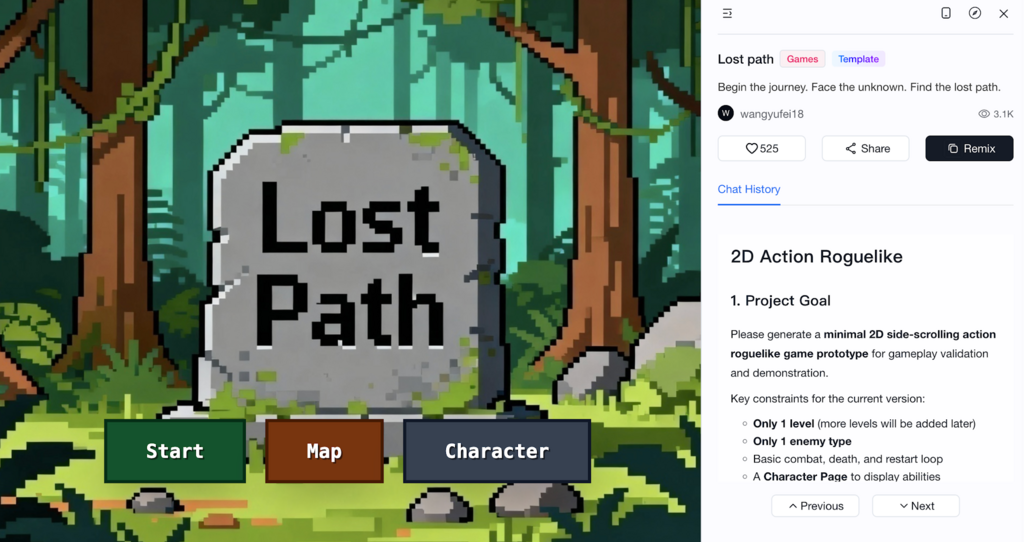
For decades, game development was considered the most technically demanding sector of the software industry. Even to build a simple, interactive 2D maze, a retro arcade game, or a casual puzzle application, creators had to master heavy physics engines, complex rendering loops, and intricate state management frameworks. For independent designers, educators, and creative solo founders, the steep learning curve meant most game ideas never left the drafting board.
The traditional friction wasn’t just about logic; it was about the fragmented workflow of assembling assets, managing coordinate math, and debugging collision scripts. But in 2026, the barrier between a creative concept and an interactive, playable experience has completely dissolved.
Shifting from Complex Game Physics to Vibe Coding
The modern evolution of software generation treats game logic just like any other application flow. Instead of writing math heavy rendering algorithms locally, you can now construct fully interactive user experiences through conversational scripting. This fast-paced methodology allows non-technical creators to focus purely on game mechanics, narrative progression, and the overall player experience.
When you describe a game’s rules in plain English, an intelligent development environment interprets the underlying logic automatically. You can tell the system exactly how the players should move, what happens when they hit a specific obstacle, or how the scoring parameters should scale. The platform handles the tedious background compilation, structural mathematics, and asset mapping instantly.
Creating Genuine Value Through Highly Interactive UI
Mini-games and interactive elements are no longer just for entertainment—they are powerful tools for modern digital marketing, user onboarding, and customer retention. A standard, flat landing page rarely captures user attention anymore. However, introducing a light, custom-branded puzzle, an interactive quiz, or a beautifully animated gamified dashboard can skyrocket your website engagement metrics almost overnight.
To build an interactive asset that feels completely premium, you need a framework that supports fluid UI rendering and instant asset updates. Lightweight web wrappers often struggle with animation lag, which quickly ruins user immersion.
Platforms like MeDo bridge this gap perfectly. By allowing you to blend simple text prompts with highly responsive frontend components, your mini-games remain fast, accessible, and clean across both desktop browsers and mobile devices. You can test your interactive mechanics with real users, tweak the layout settings on the fly, and continually optimize the overall gameplay loop step by step.
3 Gamified Concepts You Can Build for Your Brand
- Interactive Brand Onboarding: Create a micro-game where users explore your product features visually, unlocking a custom discount code or premium resource at the finish line.
- Educational Micro-Puzzles: Build custom, web-based logic quizzes or matching puzzles tailored to your specific industry niche to educate your followers effortlessly.
- Gamified Productivity Portals: Design simple habit trackers or task-management boards that utilize rewarding interactive animations whenever a team member checks off a daily objective.
Conclusion: Focus on Fun, Not the Compiler
Great game design does not depend on your ability to debug memory leaks or write low-level graphics code; it depends on your understanding of user psychology, challenge, and engagement. The technical architecture behind smooth animations shouldn’t limit your creative expression.By utilizing a flexible creation platform like MeDo, you can transform game engineering into a simple dialogue. You handle the creative vision, the aesthetic pacing, and the mechanical rules, while the AI manages the pixels and processing behind the scenes. Stop holding back your creative interactive ideas—start building your first mini-game today.
